

Search
What Are the Top Water Tanks for Global Buyers?
What Are the Top Water Tanks for Global Buyers? The answer depends on climate, water quality, installation space, and local compliance. There is no universal winner. That assumption often fails.
The WHO and UNICEF Joint Monitoring Programme reported in 2023 that 2.2 billion people lacked safely managed drinking water in 2022. This figure shows why dependable water storage remains essential for homes, farms, factories, and emergency facilities. The UN World Water Development Report 2024 also highlights increasing pressure from climate variability, urban growth, and unequal water access. For global buyers, water tanks are not merely large containers. They are part of a wider water-security system.
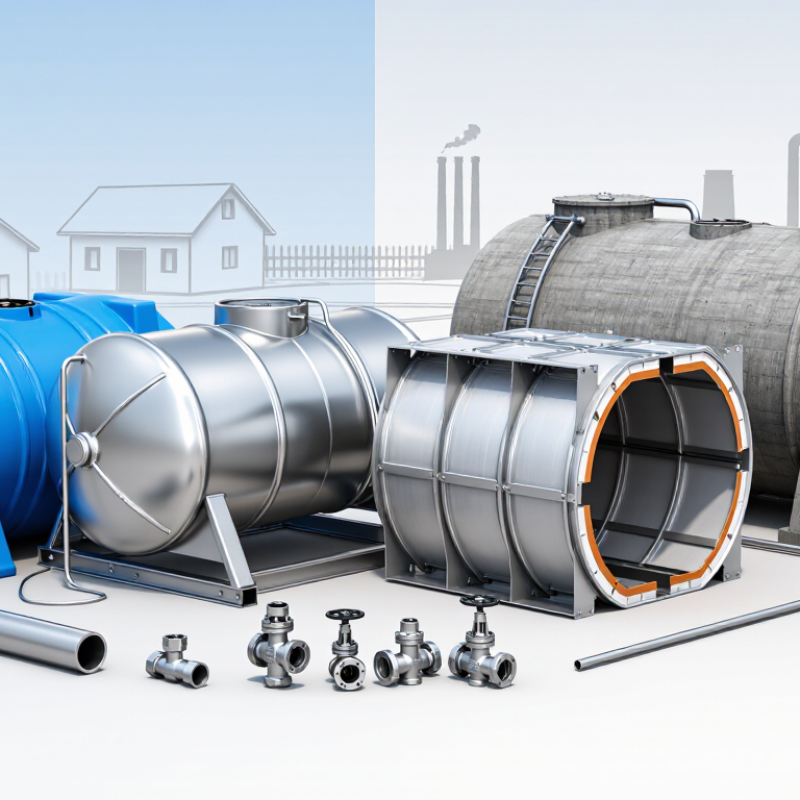
Rotomolded polyethylene tanks suit many residential and agricultural projects because they resist corrosion, remain relatively light, and install quickly. Stainless steel tanks offer stronger hygiene control and a longer service life, especially in food, beverage, and industrial settings. Sectional steel tanks with internal liners can fit large buildings where access is limited. Concrete tanks provide substantial capacity, but their construction requires careful waterproofing and structural assessment.
Material choice matters.
Buyers should examine UV resistance, wall thickness, fittings, cleaning access, temperature limits, and warranty terms. Drinking-water applications may also require certifications such as NSF/ANSI/CAN 61, WRAS approval, or AS/NZS 4020 compliance, depending on the destination market. These labels should be verified, not simply displayed in marketing brochures.
A practical comparison must include shipping volume, replacement parts, installer experience, and expected maintenance. Price alone can mislead. A low-cost tank may become expensive after difficult transport, algae growth, or premature fitting failure. Even experienced buyers can overlook local conditions. The best water tanks balance safety, durability, capacity, and total ownership cost.
Water Tank Basics: Types, Materials, and Main Uses
What Are the Top Water Tanks for Global Buyers?
Water Tank Basics: Types, Materials, and Main Uses
Water tanks differ by location, capacity, and water quality needs. Above-ground tanks simplify inspection and cleaning. Underground tanks save space but require careful waterproofing and access planning. Elevated tanks provide pressure through gravity. Modular tanks suit temporary sites, remote communities, and changing demand. Flexible tanks can support emergency storage, although punctures remain a practical concern.
Common materials include polyethylene, galvanized steel, stainless steel, concrete, and coated fabric. Polyethylene resists many chemicals and stays relatively lightweight. Steel offers strength for large industrial volumes, but corrosion protection needs regular inspection. Concrete performs well underground, yet cracks can develop through settlement. Potable-water tanks should use certified food-contact linings and closed covers. Small design details matter.
The WHO/UNICEF Joint Monitoring Programme reported that 2.2 billion people lacked safely managed drinking water in 2022. Reliable storage therefore supports resilience, especially where supply is intermittent. The UN World Water Development Report 2024 states that agriculture accounts for about 70% of global freshwater withdrawals. Agricultural tanks need durable outlets, sediment control, and simple maintenance. Domestic tanks need smooth interiors and safe overflow routes. Buyers should check local seismic, fire, sanitation, and structural requirements before ordering. No material is perfect. A larger tank can reduce shortages, but it may increase cleaning effort, dead storage, and installation cost. Personally, I would assess the water source first, then select the tank material.
What Are the Top Water Tanks for Global Buyers? - Water Tank Basics: Types, Materials, and Main Uses
| Tank Type | Common Materials | Typical Capacity Range | Main Uses | Key Advantages | Main Limitations | Best Fit for Global Buyers |
|---|---|---|---|---|---|---|
| Polyethylene Rotational-Molded Tank | UV-stabilized polyethylene, commonly HDPE | Approximately 200–50,000 L | Rainwater harvesting, potable water storage, agriculture, residential and commercial supply | Lightweight, corrosion-resistant, easy to transport, relatively simple installation, low maintenance | Can expand or deform if poorly supported; may require protection from excessive heat and impact | Residential, agricultural, and general-purpose projects where fast delivery and easy handling matter |
| GRP/FRP Panel Tank | Glass-fiber-reinforced plastic with resin panels and internal liners | Approximately 1–5,000 m³ | Commercial buildings, fire-water storage, municipal facilities, industrial water systems | Modular design, corrosion resistance, convenient transport in sections, flexible capacity configuration | Requires professional assembly and careful sealing; fittings and liners need regular inspection | Projects needing large capacity, modular shipping, and installation in locations with restricted access |
| Stainless Steel Tank | Stainless steel, often grades selected for corrosion resistance and hygiene requirements | Approximately 500–100,000 L | Potable water, food and beverage processing, healthcare, laboratories, and industrial applications | Durable, hygienic, easy to clean, resistant to many chemicals and high temperatures | Higher purchase cost; may be affected by unsuitable water chemistry or poor welding quality | Buyers prioritizing hygiene, long service life, cleanability, and demanding water-quality conditions |
| Galvanized Steel Tank | Steel panels protected with a zinc coating, often combined with a liner | Approximately 10–5,000 m³ | Agricultural storage, fire protection, industrial and municipal water systems | Strong structural performance, modular construction, suitable for medium and large installations | Zinc coating and liners can wear over time; corrosion control is important in aggressive environments | Large-scale buyers seeking a robust modular tank with a balance between cost and capacity |
| Epoxy-Coated Steel Tank | Carbon steel with a factory-applied glass-fused or epoxy protective coating | Approximately 50–20,000 m³ | Municipal water, wastewater, fire-water systems, and industrial storage | High structural strength, scalable capacity, corrosion protection, and relatively fast site assembly | Coating damage must be repaired; installation quality and foundation accuracy are critical | Infrastructure and industrial projects requiring high volume and durable above-ground storage |
| Concrete Tank | Reinforced concrete, sometimes combined with waterproofing membranes or liners | Approximately 10–10,000+ m³ | Underground storage, municipal supply, fire protection, stormwater, and wastewater facilities | Very strong, suitable for underground construction, good thermal stability, and long potential service life | Heavy and difficult to relocate; construction takes longer and cracking or leakage must be controlled | Permanent infrastructure projects with substantial foundations, land, and local construction resources |
| Flexible Bladder Tank | Flexible PVC, polyurethane, or other coated technical fabrics | Approximately 1–500 m³ | Temporary water supply, rainwater, emergency response, irrigation, and remote-site storage | Foldable, lightweight, quick to deploy, and economical for temporary or low-profile applications | Vulnerable to punctures, sharp objects, abrasion, and unsuitable environmental conditions | Humanitarian, agricultural, construction, and emergency projects where portability is essential |
| Corrugated Steel Tank | Corrugated steel panels with galvanized, epoxy, or other protective finishes | Approximately 50–15,000 m³ | Fire-water storage, agriculture, industrial water, wastewater, and rainwater harvesting | Modular, strong, transport-efficient, and available in many diameter and height combinations | Needs a level foundation and corrosion protection; liner or coating maintenance may be required | International projects requiring scalable capacity and shipment in panels rather than as a single vessel |
Capacity ranges are indicative and vary by engineering design, local regulations, site conditions, water quality, and manufacturer specifications. Potable-water applications should use materials and liners approved for contact with drinking water in the target market.
Related Posts
-
10 Best Water Tanks for Home and Commercial Use
-
China Best Water Tanks for Global Buyers?
-
How to Choose the Right Water Tanks for Your Needs?
-
How to Choose the Right Water Tanks for Your Needs?
-
Top 10 Well Tanks in China for Global Buyers Needs?
-
How to Choose the Right Large Water Storage Tanks for Your Needs?