Search

China Top Steel Tanks Manufacturers and Suppliers

China has become an important sourcing destination for steel tanks used in water treatment, chemical processing, food production, agriculture, and energy projects. This guide examines China’s top steel tanks manufacturers and suppliers through practical, measurable factors. Product quality matters. So does communication.

Reliable manufacturers usually provide material certificates, welding records, dimensional drawings, coating details, and pressure or leak-test reports. Experienced teams can explain steel grades, tank capacity, corrosion protection, insulation, fittings, and installation requirements. They should also discuss project conditions clearly, including temperature, media characteristics, site access, and local standards.

Details reveal capability.

A tank may look simple in a catalog, yet its performance depends on weld consistency, nozzle placement, surface preparation, and internal support design. Factory visits, sample inspections, and third-party testing can help buyers verify what photographs cannot show. Some suppliers offer strong fabrication skills but limited export support. Others communicate well but rely heavily on subcontractors. This difference deserves careful attention.

The most dependable supplier is not always the cheapest. A lower quotation may exclude coatings, transport protection, inspection, or commissioning guidance. Buyers should compare complete specifications, delivery terms, warranty coverage, spare parts, and after-sales service. Clear documentation builds confidence. Honest limitations matter too.

This overview aims to support informed supplier evaluation, not promote one company without evidence. Requirements vary by industry and location. A suitable partner should demonstrate relevant experience, technical competence, traceable production, and consistent customer support. Steel tanks are long-term assets. Choosing carefully can reduce maintenance problems and protect project performance.
China Top Steel Tanks Manufacturers and Suppliers

Types of Steel Tanks Made by Chinese Manufacturers

China Top Steel Tanks Manufacturers and Suppliers
Types of Steel Tanks Made by Chinese Manufacturers

Chinese steel tank manufacturers supply practical storage systems for water, chemicals, food ingredients, and industrial liquids. Carbon steel tanks offer strength and cost efficiency for many general applications. Stainless steel tanks resist corrosion and support cleaner processing environments. Glass-fused tanks provide durable protection for municipal and industrial storage. Epoxy-lined tanks add another barrier against internal corrosion. Material choice matters.

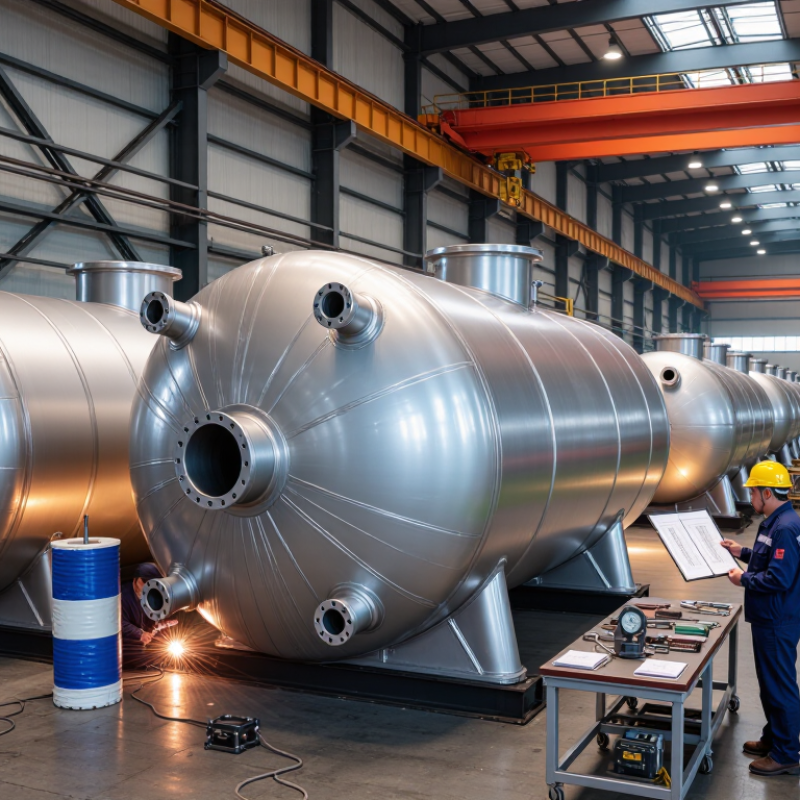
Common designs include vertical storage tanks, horizontal tanks, bolted tanks, and welded tanks. Vertical tanks suit large capacities where floor space is limited. Horizontal tanks work well in transport, drainage, and low-height installations. Bolted tanks can simplify delivery and assembly at remote sites. Welded tanks usually provide rigid construction and customized dimensions. Some suppliers also fabricate pressure-rated vessels under applicable engineering codes. These products require stricter design reviews and testing.

Reliable manufacturers normally control steel traceability, welding procedures, coating thickness, and dimensional accuracy. They may use ultrasonic testing, visual inspection, and hydrostatic testing before shipment. Inspection records should match the tank number and production drawings. Buyers should request material certificates, test reports, drawings, and maintenance guidance. One weakness deserves attention: a low quotation can hide thinner plates or limited inspection. A polished brochure proves little. Clear specifications matter more. Oversights still happen, especially when operating temperature, foundation loads, or liquid compatibility remain unclear.

Key Materials and Manufacturing Standards

China Top Steel Tanks Manufacturers and Suppliers: Key Materials and Manufacturing Standards

Material selection controls tank life, safety, and maintenance cost. The World Steel Association reported 1.89 billion tonnes of crude steel production in 2023. This scale supports broad material availability, but availability does not guarantee quality. Carbon steel suits many water, oil, and dry-bulk applications. Stainless steel, especially 304L or 316L, offers stronger corrosion resistance. Duplex grades can improve strength in aggressive environments, although welding control becomes more demanding. In practice, suppliers should provide mill certificates, chemical analysis, and traceability for every plate.

Manufacturing standards turn raw steel into a dependable vessel. API 650 commonly guides welded atmospheric storage tanks, while ASME Section VIII applies to many pressure vessels. EN 13445 may be required for unfired pressure equipment in European projects. ISO 3834 strengthens welding quality management, including qualified procedures and welder competence. Non-destructive testing should match the design risk. Ultrasonic, radiographic, dye penetrant, or magnetic particle testing may reveal defects that visual checks miss. A lower quotation can hide thinner plates, limited testing, or weak documentation. That deserves careful review.

Tips: Request drawings, welding procedures, inspection plans, and coating specifications before production. Confirm design pressure, temperature, corrosion allowance, and service medium. Check whether factory acceptance testing includes dimensional inspection and leak testing. Also question unclear claims. “Compliant” is not enough without the applicable standard and inspection record. Mistakes still occur, even in certified facilities. Clear evidence matters more than polished promises.

How to Evaluate Chinese Steel Tank Suppliers

Evaluating Chinese steel tank suppliers requires more than comparing catalog prices. China produced about 1.005 billion tonnes of crude steel in 2024, representing roughly 53% of global output, according to the World Steel Association. This scale is useful, but it does not prove tank quality. Ask for the steel grade, mill certificates, welding procedure specifications, and recent hydrostatic test records. A serious supplier should identify plate thickness, design pressure, corrosion allowance, and working temperature clearly.

Inspect the factory through a live video call or an independent audit. Look for clean welding areas, calibrated gauges, controlled blasting, and traceable serial numbers. Request inspection records from cutting to final coating. The ISO Survey reports China as having hundreds of thousands of ISO 9001 certificates, yet certification alone cannot verify a tank’s fabrication skill. Check whether the certificate covers the actual production site and relevant manufacturing scope. Small detail, big difference.

For export projects, compare the supplier’s design with applicable pressure-vessel or storage-tank codes. Request material traceability from each plate to the finished vessel. Review non-destructive testing methods, repair procedures, packing photographs, and after-sales response times. OECD steel industry reports repeatedly highlight overcapacity and cost pressure in global steel markets; unusually low quotations may reflect thinner specifications, weaker inspection, or omitted documentation. I have seen apparently complete offers miss foundation loads and drain details. That mistake becomes expensive after installation. Allow time for technical clarification, not just negotiation.

How to Evaluate Chinese Steel Tank Suppliers

This illustrative procurement framework assigns a 100-point evaluation weight across the factors most relevant to industrial steel tank sourcing: compliance, quality assurance, technical capability, manufacturing capacity, delivery reliability, total cost, and after-sales support. Buyers should adjust the weighting according to tank type, pressure requirements, applicable standards, and project risk.

Customization, Quality Control, and Certification

China’s steel tank manufacturers serve chemical, water, energy, and food-processing projects with highly customized designs. According to World Steel Association data, China produced about 1.02 billion tonnes of crude steel in 2023. This scale supports material availability, but volume alone does not prove tank quality.

Customization should begin with operating conditions, not a standard drawing. Engineers assess capacity, temperature, pressure, corrosion exposure, and site access. They may select carbon steel, stainless steel, or internal lining systems. Plate thickness, nozzle position, welding access, and transport limits require careful review. Small design errors can create expensive installation problems.

Quality control needs visible evidence. Reliable suppliers document heat numbers, material certificates, weld procedures, welder qualifications, dimensional checks, and hydrostatic testing. ISO 3834 supports controlled welding quality, while ISO 9001 helps structure documented production processes. EN 10204 inspection certificates can link steel plates to test results. ASME or other local certifications may apply to pressure equipment, depending on the destination.

Certification is useful, but it is not a guarantee. Inspectors should verify certificate scope, issuing body, traceability, and renewal status. The World Steel Association reported global crude steel production near 1.89 billion tonnes in 2023, showing the industry’s scale, not uniform reliability. A practical factory audit should include weld samples, coating thickness readings, calibration records, and photographs of hidden surfaces. Even experienced teams miss details. Clear drawings and independent inspection reduce that risk.

China Top Steel Tanks Manufacturers and Suppliers - Customization, Quality Control, and Certification
Tank Type Typical Capacity Range Common Materials Applicable Design Standards Customization Options Typical Quality-Control Activities Relevant Certifications or Compliance
Atmospheric Storage Tanks 10–100,000 m³ Carbon steel, low-alloy steel, stainless steel 304/316L API 650, EN 14015, GB 50128 Fixed roof, floating roof, cone roof, insulation, heating coils, internal lining, stairways and platforms Material traceability, dimensional inspection, weld visual inspection, ultrasonic or radiographic testing, hydrostatic testing ISO 9001 quality management; welding procedures and inspections aligned with the selected project standard
Pressure Vessels 0.1–5,000 m³ Carbon steel, stainless steel, alloy steel ASME Section VIII, GB/T 150, EN 13445 Design pressure, operating temperature, nozzle arrangement, supports, corrosion allowance and surface finish Welding procedure qualification, welder qualification review, non-destructive examination, pressure testing and safety-relief connection inspection ASME certification or local statutory approval where required; ISO 3834 welding-quality systems may be specified
Chemical Storage Tanks 1–10,000 m³ 316L stainless steel, carbon steel with compatible lining, duplex stainless steel for selected services API 650, EN 14015, project-specific chemical-service specifications PTFE, rubber or glass-flake lining, agitators, dosing connections, bund integration and corrosion-resistant internals Chemical compatibility review, weld penetrant testing, lining thickness testing, holiday testing and leak testing ISO 9001; material certificates and coating or lining inspection reports supplied according to contract requirements
Water and Wastewater Tanks 50–20,000 m³ Carbon steel with protective coating, galvanized steel, stainless steel AWWA D100, API 650, EN 14015, applicable local codes Open or closed roof, mixing system, anti-corrosion lining, overflow, access manholes and level instrumentation Coating surface-preparation inspection, dry-film thickness measurement, weld inspection, water filling test and dimensional checks ISO 9001; coating and material documentation based on the specified water-service requirements
Food and Beverage Tanks 0.5–500 m³ Stainless steel 304/304L or 316/316L ASME Section VIII for pressure service; sanitary design requirements specified by the purchaser Sanitary fittings, polished internal surfaces, CIP spray balls, jacketed shell, agitators and load cells Surface-finish inspection, weld visual inspection, dye-penetrant testing, pressure or leak testing and cleaning verification Food-contact documentation, material certificates and hygienic-design records as required by the destination market
LPG and Cryogenic Tanks 10–5,000 m³ Low-temperature carbon steel, low-alloy steel, stainless steel and aluminum alloys where specified ASME Section VIII, EN 13445, applicable pressure-equipment regulations Horizontal or vertical configuration, double-wall construction, vacuum insulation, relief devices and specialized valves Low-temperature impact testing, radiographic or ultrasonic examination, pressure testing, vacuum testing and relief-device verification Applicable pressure-equipment certification, inspection-body review and transport or installation approvals where required
Modular or Bolted Steel Tanks 50–10,000 m³ Coated carbon steel, galvanized steel, enamel-coated steel or stainless steel panels Project specifications, AWWA D103 where applicable, and local structural requirements Panel dimensions, tank height, roof system, liners, insulation, pipe connections and on-site assembly method Panel coating inspection, bolt-torque verification, liner inspection, dimensional checks and water-tightness testing ISO 9001; coating, liner and fastener documentation provided according to the agreed quality plan
Data note: Capacity ranges and material selections are typical industry planning ranges, not company-specific guarantees. Final design, certification route, inspection scope and applicable standards depend on the stored medium, operating conditions, installation location and purchaser requirements.

Export Services, Pricing, and Supplier Selection Criteria

China Top Steel Tanks Manufacturers and Suppliers

Export Services, Pricing, and Supplier Selection Criteria

Selecting a Chinese steel tank manufacturer requires more than comparing website photos and quoted prices. Export experience matters when drawings, inspection records, and shipping schedules must align. Ask for material certificates, weld procedures, coating specifications, and pressure-test evidence. These documents reveal process control. An experienced supplier should explain how tanks are packed, lifted, protected, and marked for overseas delivery. Details matter.

Export service should cover technical confirmation, commercial invoices, packing lists, certificates of origin, and responsive after-sales communication. Clarify FOB, CIF, or another agreed term before payment discussions begin. Confirm port arrangements and responsibility for inland transport, insurance, customs paperwork, and destination unloading. Small omissions can create expensive delays. That risk is easy to underestimate.

Pricing depends on steel grade, capacity, wall thickness, fittings, surface treatment, testing, packaging, and order volume. Compare like-for-like specifications, not only the total figure. Request a staged quotation with exclusions clearly listed. Include lead time, warranty scope, spare parts, payment schedule, and inspection options. An independent inspection can verify dimensions and weld quality before shipment. I have seen low bids change after technical details were clarified. That lesson is uncomfortable. Still, it protects the budget. Choose a supplier that answers precise questions consistently, even when the answer is not convenient.