
Choosing the right polyimide tape supplier can affect production quality, delivery stability, and long-term operating costs. Global buyers often compare suppliers by price alone. That approach can create expensive surprises later.
This guide examines ten leading suppliers for industrial and electronic applications. It considers adhesive performance, temperature resistance, dielectric strength, thickness control, and roll consistency. It also reviews sample policies, minimum order quantities, lead times, packaging, and technical support. These details matter when tape must protect circuit boards, insulate coils, or withstand repeated heat cycles. A reliable supplier should provide clear datasheets, traceable quality records, and practical test samples. Certifications can support confidence, but buyers should still verify current documents and product specifications.
Real purchasing experience shows that small differences can become major production problems. Uneven edges may complicate automated application. Excess adhesive can leave residue after thermal processing. A delayed shipment can interrupt an entire assembly line. No supplier is perfect. Even a respected manufacturer may have limits involving customization, regional service, or urgent orders. That point deserves honest reflection.
The suppliers discussed here are evaluated from a buyer’s practical perspective, not through promotional claims alone. Comparing factory capability, export experience, inspection procedures, and communication quality can reveal meaningful differences. Buyers should match each supplier with their own operating conditions, equipment, and compliance requirements. A low quotation may not represent the lowest total cost. Careful sampling remains essential before large-scale purchasing. This introduction provides a clear starting point for global buyers seeking dependable tape solutions and more informed supplier decisions.
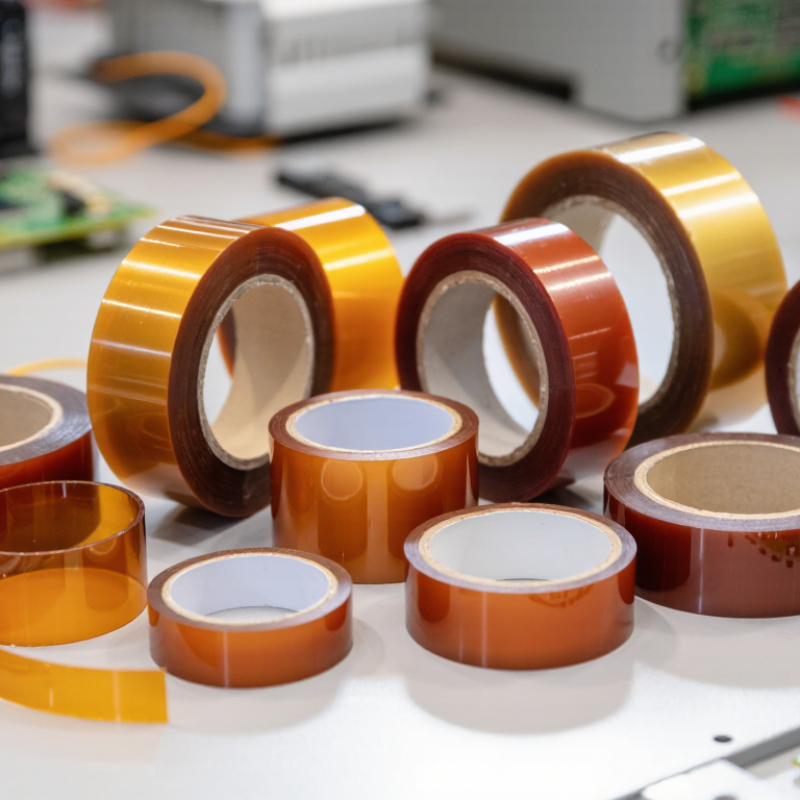
Polyimide tape is a pressure-sensitive tape made with a thin polyimide film and silicone adhesive. Its value comes from heat resistance, electrical insulation, and dimensional stability. Many industrial grades operate near 200–260°C, although performance depends on adhesive type, exposure time, and surface condition. It is not simply “heatproof.” That label can mislead buyers.
In electronics manufacturing, technicians use it to mask circuit-board contacts during soldering and reflow. It also wraps transformer windings, secures flexible circuits, and protects battery components during controlled assembly. Semiconductor facilities apply specialized grades during wafer processing, where low residue matters. In workshops, the amber film often covers 3D-printer beds, powder-coating areas, and wiring exposed to brief heat. The tape should be pressed onto clean, dry surfaces. Dust creates tiny channels under the adhesive.
Market data supports its growing industrial role. Grand View Research forecasts the global polyimide films market to expand at approximately 6.6% annually from 2024 to 2030, driven largely by electronics and transportation applications. Fortune Business Insights reports a different market value and growth path because its research includes different product categories and regional assumptions. That difference deserves attention. Buyers should compare temperature ratings, dielectric strength, thickness tolerance, peel adhesion, and residue test results rather than selecting by price alone. In practical audits, a tape that survives a hot cycle may still fail after repeated bending or prolonged chemical contact.
Choosing among polyimide tape suppliers requires more than comparing price lists. In practical sourcing, I examine the tape’s thickness tolerance, adhesive type, temperature range, dielectric strength, and peel performance. A supplier should provide recent test reports, technical data sheets, and batch traceability. Ask for samples from different production lots. One perfect roll proves very little.
A reliable supplier explains how materials are stored, coated, slit, and packed. Small details matter. Check whether the tape arrives with clean edges, stable winding, and readable labels. Request production photos or arrange a remote factory audit when travel is difficult. Certifications can support credibility, but they should match the actual product and market. Vague documents deserve careful questioning.
Global purchasing adds practical risks. Review lead times, export packaging, customs documents, payment terms, and replacement procedures before placing a large order. Communication speed also matters when a roll fails during assembly. I once underestimated the cost of delayed samples; the purchase price looked attractive, but testing consumed valuable production time. No checklist is perfect. Suppliers may also struggle with unusual widths or high-temperature applications, so state the operating conditions clearly. Compare total supply reliability, not only the lowest quotation.
Selecting the 10 best polyimide tape suppliers requires more than comparing price. Key features include stable thickness, clean adhesive coating, strong dielectric performance, and clear temperature ratings. MarketsandMarkets estimates the polyimide film market will grow at about 6.2% annually through 2028. That growth reflects demand from electronics, aerospace, batteries, and flexible circuits.
Reliable suppliers provide batch traceability, technical data sheets, and samples from current production lots. Look for tapes with controlled thickness, consistent peel strength, and tested thermal resistance near 260°C. Adhesive choice matters too. Silicone adhesives suit high-temperature removal, while acrylic systems may offer stronger bonding on clean metal surfaces. Global buyers should also check slitting accuracy, packaging quality, export experience, and response time. A supplier may claim excellent performance, yet vague test conditions weaken that claim. Real experience often reveals the gap.
Tips: Request three sample widths and test them on your actual substrate. Record peel force after heat aging. Ask for results using recognized methods, such as ASTM or IEC procedures. Verify whether values apply to the tape, adhesive, or backing film. Do not rely only on a glossy catalog. A small mistake in liner release or roll winding can stop an automated production line. Supplier audits, video inspections, and signed inspection reports add useful evidence, although they cannot replace independent testing.
This chart presents representative technical benchmarks commonly used by global buyers when evaluating polyimide tape suppliers. Temperature resistance, dielectric strength, thickness options, tensile strength, and adhesive reliability are key selection criteria; actual specifications vary by grade, backing thickness, adhesive system, and certification.
When comparing polyimide tape suppliers, start with measurable quality, not attractive samples. Check thickness tolerance, adhesive uniformity, dielectric strength, and thermal performance. A tape rated for 260°C may still fail after repeated heating cycles. Request batch test reports, lot traceability, and aging results. The 2024 Grand View Research outlook estimates the global polyimide films market will grow steadily through 2030, driven by electronics and flexible circuits. That growth also attracts inconsistent converters. A polished datasheet is not proof.
Pricing needs a wider view. Compare tape width, roll length, core size, minimum order quantity, tooling fees, and delivered cost. A low unit price can hide high waste from uneven slitting. Ask whether quotations include freight, customs paperwork, and inspection charges. For certifications, verify the certificate holder, covered factory, issue date, and product scope. ISO 9001 supports process control, while RoHS and REACH documents address material compliance. UL recognition, when relevant, should match the exact construction, not merely the adhesive family. IPC workmanship guidance can help define inspection expectations.
Tips: Test three production lots, not one hand-cut sample. Measure peel strength after heat exposure. Keep a small delivery buffer. Supplier promises are useful, but records matter more. According to the 2024 MHI Annual Industry Report, supply-chain visibility remains a major operational priority for manufacturers. Ask for on-time delivery data, standard lead time, escalation contacts, and packaging photos. I would also challenge my own assumptions: the cheapest supplier may perform well, while an expensive one may offer weak traceability. Compare evidence, then decide.
| Rank | Anonymous Supplier Profile | Best-Fit Application | Typical Tape Construction | Common Thickness Range | Typical Continuous-Use Temperature | Adhesive Options | Indicative Price Range (USD/m²) | Typical MOQ | Standard Production Lead Time | Quality & Compliance Documents to Request | Buyer Evaluation Score |
|---|---|---|---|---|---|---|---|---|---|---|---|
| 1 | Supplier Profile A High-volume international converter | Automotive electronics, battery insulation, coil and transformer work | Polyimide film with silicone pressure-sensitive adhesive; optional PET release liner | 0.025–0.100 mm | Approximately −73°C to 260°C, depending on adhesive system | Silicone Acrylic available for selected designs | $2.80–$8.50 | 500–2,000 m² | 3–6 weeks | Technical data sheet, certificate of analysis, RoHS, REACH, UL 510 or equivalent evidence where applicable, lot traceability | 9.3 / 10 |
| 2 | Supplier Profile B Precision slitting and die-cutting specialist | PCB masking, semiconductor processing, precision electrical insulation | Low-contamination polyimide film with controlled silicone coating | 0.020–0.080 mm | Approximately −60°C to 200–260°C, product dependent | Low-residue silicone Custom adhesive coat weights | $4.50–$14.00 | 100–500 m² | 2–5 weeks | Coating-weight report, dimensional inspection report, outgassing or ionic-contamination data when required, RoHS and REACH declarations | 9.1 / 10 |
| 3 | Supplier Profile C Certified industrial insulation supplier | Motor winding, transformer insulation, generator maintenance | Polyimide film with thermosetting or pressure-sensitive silicone adhesive | 0.050–0.180 mm | Approximately 180–260°C, depending on insulation system | Thermosetting silicone Pressure-sensitive silicone | $3.80–$10.50 | 300–1,000 m² | 4–8 weeks | Electrical breakdown test results, dielectric-strength data, UL recognition information where applicable, ISO 9001 certificate, batch records | 8.9 / 10 |
| 4 | Supplier Profile D Flexible electronics and battery-pack specialist | Battery tabs, cell wrapping, busbar insulation, flexible circuits | Thin polyimide film with flame-retardant silicone adhesive options | 0.025–0.125 mm | Approximately −40°C to 200–260°C | Flame-retardant silicone Standard silicone | $3.20–$9.80 | 200–800 m² | 3–7 weeks | Flammability information, dielectric-strength report, dimensional tolerance data, RoHS, REACH, conflict-minerals statement where requested | 8.8 / 10 |
| 5 | Supplier Profile E Regional stock-and-convert distributor | Maintenance, repair, prototyping and short production runs | Commercial-grade polyimide film with silicone adhesive; slit rolls and sheets | 0.030–0.100 mm | Approximately −60°C to 200°C | General-purpose silicone | $6.00–$18.00 | 10–100 m² | 1–3 weeks from stock; 4–6 weeks for custom sizes | Product data sheet, batch identification, RoHS and REACH declarations, sample approval record | 8.6 / 10 |
| 6 | Supplier Profile F Cost-focused mass-production converter | General electrical masking, soldering protection and cable wrapping | Standard polyimide film with single-sided silicone adhesive | 0.025–0.100 mm | Approximately −40°C to 180–260°C, specification dependent | Standard silicone | $1.80–$5.50 | 1,000–5,000 m² | 4–8 weeks | Technical data sheet, certificate of analysis, adhesive-residue test, RoHS and REACH declarations, carton and core specifications | 8.4 / 10 |
| 7 | Supplier Profile G Custom adhesive-formulation supplier | High-temperature masking, powder coating and specialty assembly | Polyimide film with customized silicone or modified acrylic adhesive | 0.030–0.150 mm | Approximately 150–260°C, depending on adhesive chemistry | Custom silicone Modified acrylic options | $4.00–$12.50 | 300–1,500 m² | 5–9 weeks | Adhesion and peel-strength data, temperature-aging results, residue testing, SDS, RoHS, REACH and change-control procedure | 8.3 / 10 |
| 8 | Supplier Profile H Export-oriented private-label converter | Industrial OEM programs requiring printed packaging and private labeling | Standard and colored polyimide film with silicone adhesive | 0.025–0.125 mm | Approximately −60°C to 200–260°C | Silicone Double-sided constructions available | $2.20–$7.50 | 500–3,000 m² | 4–7 weeks plus transit time | Pre-shipment inspection report, certificate of origin, RoHS, REACH, packing list, lot traceability and agreed sample standard | 8.1 / 10 |
| 9 | Supplier Profile I Small-batch engineering supplier | Product development, laboratory use and low-volume custom parts | Thin polyimide film supplied in rolls, strips, sheets or die-cut forms | 0.020–0.075 mm | Approximately −40°C to 200–260°C | Low-residue silicone | $8.00–$25.00 | 5–50 m² | 1–4 weeks | Sample dimensional report, adhesive peel and tack data, material declaration, SDS and application test results | 7.9 / 10 |
| 10 | Supplier Profile J Integrated film, coating and converting supplier | Long-term OEM supply requiring process control and custom specifications | Engineered polyimide film with controlled coating weight, custom widths and die cuts | 0.025–0.200 mm | Approximately −73°C to 260°C, product and adhesive dependent | Silicone Thermosetting and custom systems | $5.00–$16.00 | 500–2,500 m² | 6–10 weeks for qualified custom products | ISO 9001 evidence, process-control plan, first-article inspection, certificate of analysis, RoHS, REACH and customer-specific quality agreement | 7.8 / 10 |
Comparison basis: The prices, minimum order quantities and lead times are indicative industry ranges for polyimide adhesive tape and may vary by film thickness, adhesive formulation, width, roll length, die-cut complexity, order volume, testing requirements and shipping destination. Temperature ratings are application-dependent and should be confirmed using the supplier’s technical data sheet. Certification and compliance documents should be verified for the exact product, manufacturing site and shipment lot before purchase.
Choosing a global polyimide tape supplier starts with the application, not the catalog. Polyimide films support electronics, aerospace, insulation, and high-temperature assembly. Grand View Research estimated the global polyimide film market at about USD 1.1 billion in 2023, with continued growth through 2030. That trend increases supplier choices, but not necessarily supplier quality.
Ask for measurable evidence. Confirm tape thickness, adhesive type, dielectric strength, temperature range, peel adhesion, and storage life. Request a recent certificate of analysis and lot traceability. A reliable supplier should provide test methods, not only attractive numbers. Samples matter. Test them on your actual substrate, curing cycle, and application pressure. Do not guess.
Compare at least three suppliers using the same specification sheet. Check production capacity, minimum order quantity, export experience, packaging, and realistic lead times. Fortune Business Insights projected the polyimide film market to grow from approximately USD 1.11 billion in 2023 to USD 1.80 billion by 2032. This growth can pressure capacity during demand spikes. Ask about allocation policies and backup production. Review shipment records carefully. A low quotation may hide inconsistent adhesive coating or expensive delays. My practical caution is simple: one successful sample proves very little. Require a controlled trial, written quality terms, and a second-lot inspection before approving regular orders.
