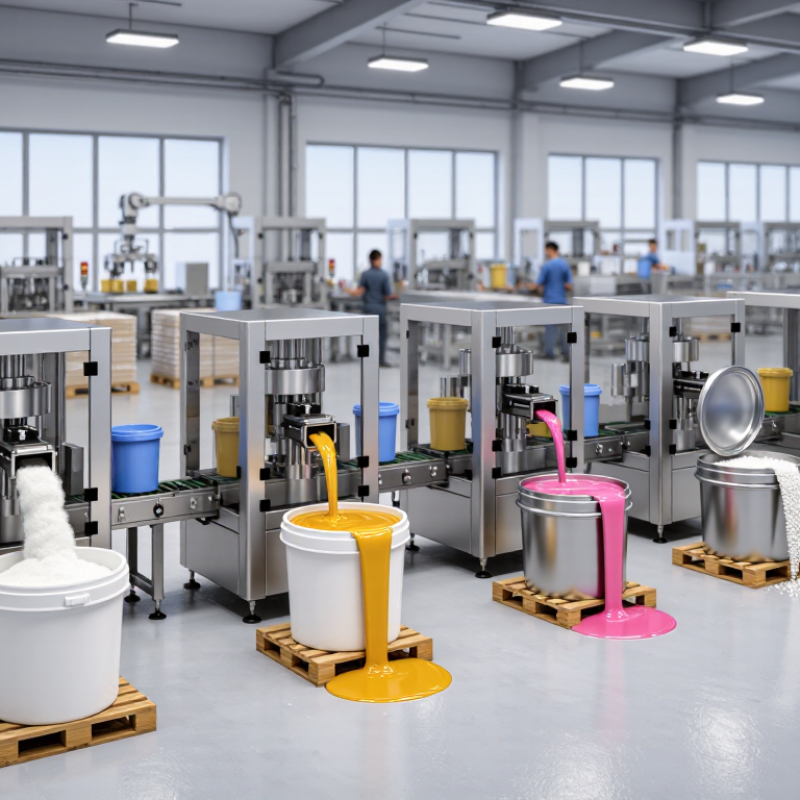
Choosing the right Bucket Filling Machine can affect product quality, labor costs, and long-term production stability. The decision is rarely about speed alone. Powder, liquid, paste, and granular products behave differently inside a filling system. Container shape matters too. A five-gallon pail may flex under pressure, while a rigid bucket may require different gripping and sealing methods.
PMMI’s 2024 State of the Industry report identifies labor shortages, automation, and flexible production as major packaging machinery priorities. Its findings support a practical question: can the machine deliver consistent fills with fewer manual adjustments? Mordor Intelligence’s packaging machinery analysis also points to automation and improved process control as continuing market drivers. These trends matter on the factory floor, where a small filling error can create visible waste beside a pallet of finished buckets.
John R. Henry, author of The Packaging Machinery Handbook, offers a useful principle: “Select equipment around the product, container, and process—not speed alone.” That advice remains highly relevant. A fast machine is not automatically the best Bucket Filling Machine. Check accuracy, cleaning access, changeover time, dust control, and service support. Watch a live demonstration if possible. Ask for test results using your actual product.
Some specifications look impressive but prove incomplete. That is worth admitting. Real performance may change with temperature, viscosity, moisture, or operator experience. The strongest choice balances measurable output with practical maintenance. It should also leave room for future product sizes and regulatory requirements. Data guides the decision, but careful observation often reveals what brochures miss.
Define the product before comparing machines. Measure its viscosity, temperature, density, and particle size. A thin liquid may fill quickly but create splashing. Thick material may need heated lines or a stronger pump. Products with foam require slower filling and careful nozzle control. Check whether the formula is abrasive, corrosive, or sensitive to contamination. In my experience, a small product sample reveals problems that specifications often miss.
Then study the container. Record the bucket’s height, diameter, opening size, wall strength, and handle position. A flexible bucket can tilt during filling. A narrow opening may cause spills around the nozzle. Confirm the target weight and acceptable filling tolerance. Also consider lid placement and conveyor spacing. Measure real buckets, not only supplier drawings. Small differences matter.
Production requirements shape the final choice. Define hourly output, working shifts, changeover frequency, cleaning methods, and available floor space. Ask how operators will adjust recipes and inspect fill weight. A machine running beside a dusty loading area may need better protection. A five-minute test is not enough. Run several hours with actual product and containers. Watch for foam, dripping, unstable buckets, and operator fatigue. Some assumptions will be wrong. Revise them before purchasing.
Choosing the best bucket filling machine starts with the material, not the machine’s appearance.
Granular products often suit gravity fillers or net weigh systems. Powders usually need auger fillers with controlled screw movement. Thick liquids require piston or pump-based fillers.
Each type handles flow differently. Gravity filling is simple and affordable, but density changes can reduce accuracy. Auger filling offers better powder control, although bridging may occur inside the hopper. Net weigh filling improves precision for valuable products, but it needs stable load cells and calibration.
Operating methods also affect production results.
Intermittent filling places buckets beneath the nozzle, fills them, and then moves them forward. It suits flexible production and frequent product changes.
Continuous systems maintain a steady flow and higher output. However, they demand consistent bucket spacing and careful synchronization.
In practical testing, small errors often come from vibration, foam, or uneven material flow. A machine may perform well during a short trial, yet behave differently after several hours. That is easy to overlook.
Tips:
Test the actual product before purchasing. Check fill accuracy, cleaning access, and changeover time. Ask for repeated trials, not one successful sample.
Record variations between buckets. Leave room for improvement, because operating conditions rarely remain perfect.
Calibration should follow written procedures and verified measuring equipment. Safety guards, emergency stops, and dust control also deserve close attention.
Accuracy should be tested with your actual product, not only with water or sample pellets. Check the average fill weight, weight variation, and rejected buckets during a full production run. A reliable machine should maintain stable results when the hopper level changes. Load cells, controlled gates, and automatic calibration can improve consistency. Still, calibration needs regular checking. Dust can quietly affect sensors.
Speed matters, but maximum speed is rarely the best operating speed. Compare buckets per minute with the acceptable error rate, cleaning time, and changeover time. A machine running at 60 buckets per minute may be less productive if it creates frequent rejects. Ask for trial data from several speed settings. Observe the feeder, discharge point, and conveyor during continuous operation. Small delays often appear after the first hour.
Material compatibility deserves close attention. Granules may flow smoothly, while powders can bridge, compact, or create dust. Moist products may stick to contact surfaces. Abrasive materials can wear feeding parts faster than expected. Confirm the machine’s contact materials, sealing design, hopper shape, and cleaning method. Test your smallest and largest bucket sizes. A practical trial is essential. One weakness in many evaluations is focusing on the machine alone. Product temperature, humidity, and operator technique can change results. Record these conditions before making a purchase decision.
How to Choose the Best Bucket Filling Machine?
Check Machine Design, Automation, Safety, and Maintenance
Choosing a bucket filling machine begins with the product, not the brochure. Check the bucket range, target weight, material flow, and daily output. A dusty powder needs sealed contact parts and controlled feeding. Sticky material may require vibration, scraping, or a different hopper shape. Ask for test runs using your actual product. Numbers on paper can mislead.
Inspect the frame, filling head, weighing system, and discharge path. Stainless steel surfaces should have few traps where powder can collect. Tool-free access helps operators clean around nozzles and sensors. Automation should support people, not confuse them. Look for clear controls, recipe permissions, weight feedback, and fault messages that identify problems. A short trial with full and nearly empty buckets can reveal unstable dosing. It is easy to trust a smooth demonstration. That can be a mistake.
Safety needs practical checks. Guards, interlocks, emergency stops, and dust control must match the installation and local requirements. Ask how the machine behaves after a power loss. Does it restart safely, or surprise the operator? Maintenance records should list lubrication points, calibration intervals, spare sensors, and expected service time. Measure noise and inspect access height during a real shift. Efficient equipment can lose value when cleaning takes too long. Plan for tired workers, changing materials, and occasional sensor drift. Keep critical parts identifiable and service instructions close to the machine.
| Evaluation Dimension | Manual or Benchtop Filler | Semi-Automatic Filler | Automatic Linear Filler | Automatic Rotary Filler | Selection Guidance |
|---|---|---|---|---|---|
| Typical Operating Principle | Operator positions each bucket and starts the fill cycle manually. | Operator loads buckets; the machine doses the product automatically after a start command. | Buckets move through multiple filling heads in a straight-line conveyor layout. | Buckets are indexed around a rotating table for filling, and may also include capping or sealing stations. | Choose the layout that matches available floor space, labor, and required output. |
| Suitable Production Scale | Product trials, small batches, seasonal production, and frequent format changes. | Small-to-medium production where labor is available for loading and unloading. | Medium-to-high production with a stable product range and continuous conveyor flow. | High production with consistent container sizes and several integrated process stations. | Higher automation is generally justified when labor cost, production volume, or repeatability is critical. |
| Common Dosing Systems | Time-based, volumetric, auger, piston, or weigh-based dosing depending on the product. | Auger, piston, pump, cup, or net-weigh dosing with operator-assisted loading. | Multi-head volumetric, piston, auger, or net-weigh dosing synchronized with the conveyor. | Volumetric, piston, auger, or net-weigh dosing integrated into rotary indexing stations. | Use net weighing for high accuracy requirements; use piston or pump systems for many liquid products. |
| Products Commonly Handled | Powders, granules, liquids, pastes, and viscous products in controlled batches. | Dry powders, free-flowing granules, liquids, sauces, creams, and pastes. | Granules, powders, liquids, and viscous products when the formulation is consistent. | Free-flowing powders, granules, liquids, and other products compatible with synchronized dosing. | Product flowability, viscosity, foaming, dust generation, and temperature must be tested before selection. |
| Typical Filling Accuracy | Depends strongly on the operator and dosing method; repeatability is usually lower. | Typically better than manual filling because the dosing cycle is controlled automatically. | High repeatability is achievable when product density, flow, and machine settings remain stable. | High repeatability is achievable, but indexing accuracy and synchronized dosing must be maintained. | Do not compare accuracy without specifying the product, target weight, dosing method, and applicable legal tolerances. |
| Container Size Flexibility | Very flexible; changeovers are usually simple but depend on the operator. | Flexible for different bucket diameters and heights, with adjustment or change parts often required. | Good flexibility, but conveyor guides, nozzles, and recipes may require adjustment or change parts. | Usually less flexible than linear systems because tooling and station spacing are tied to the rotary format. | For many bucket sizes or frequent changeovers, favor a simple layout with tool-free or low-tool adjustments. |
| Automation Functions | Basic start, stop, and fill controls; manual bucket placement is normally required. | Programmable fill time, dose setting, foot switch, sensor control, and recipe storage may be available. | Container detection, no-bucket-no-fill, conveyor synchronization, recipe management, and automatic reject functions are common. | Indexing control, container detection, fill verification, capping or sealing coordination, and reject handling are common. | At minimum, specify no-bucket-no-fill, recipe control, and an emergency-stop circuit for production equipment. |
| Labor Requirement | Highest labor requirement because positioning and filling are largely manual. | Moderate labor requirement for loading, unloading, inspection, and material replenishment. | Lower direct labor requirement, although operators are still needed for supervision and material handling. | Low direct labor requirement when upstream and downstream equipment are integrated. | Include cleaning, replenishment, quality checks, and changeover labor—not only the filling cycle. |
| Safety Design Priorities | Stable frame, guarded moving parts, electrical protection, and clear operating instructions. | Emergency stop, guarded pinch points, protected electrical components, and safe access to the dosing area. | Interlocked guards, emergency stops, conveyor guarding, safe access for cleaning, and controlled restart after faults. | Guarding around the rotary table, interlocked access doors, emergency stops, safe indexing, and controlled restart. | Risk assessment should address entanglement, crushing, unexpected start-up, dust, noise, spills, and electrical hazards. |
| Dust and Product Containment | Often depends on operator technique; local extraction may be needed for dusty powders. | Dust covers, extraction connections, and closed transfer paths can reduce exposure and product loss. | Enclosed dosing zones and extraction connections are suitable for continuous powder handling. | Enclosures and extraction are possible, but access and cleaning around multiple stations must be considered. | For combustible dust, complete a site-specific hazard assessment and use equipment suitable for the classified area. |
| Cleaning and Sanitation | Usually easiest because of the simple construction and limited product-contact parts. | Good when contact parts are removable and tool-free; hose-down suitability depends on the design. | Requires cleaning of nozzles, conveyors, guards, sensors, and product-contact components. | Can require more time because several dosing and indexing stations may need access and inspection. | Specify hygienic materials, smooth welds, drainable parts, removable contact components, and documented cleaning procedures. |
| Changeover Requirements | Usually fast because few machine settings or parts need changing. | Typically involves nozzle height, guides, dosing settings, and sometimes change parts. | May involve conveyor guides, nozzle positions, recipes, and format parts. | May require rotary tooling, container guides, dosing adjustments, and coordinated station settings. | Ask for a demonstrated changeover using the actual bucket sizes and products. |
| Maintenance Needs | Routine cleaning, inspection, lubrication where applicable, and calibration of the dosing device. | Routine cleaning, seal inspection, sensor checks, lubrication, and periodic calibration. | Maintenance includes conveyor drives, belts, sensors, actuators, dosing components, seals, and control systems. | Maintenance includes indexing mechanisms, bearings, drives, sensors, dosing components, seals, and safety devices. | Prefer equipment with accessible components, standard wear parts, maintenance instructions, and fault diagnostics. |
| Utilities | Usually electrical power; compressed air may be needed depending on the dosing equipment. | Electrical power and often compressed air for pneumatic valves, cylinders, or actuators. | Electrical power, compressed air, and possibly dust extraction or product conveying utilities. | Electrical power, compressed air, and possibly extraction, conveying, or integrated sealing utilities. | Confirm voltage, air pressure, air quality, extraction capacity, and total connected load before installation. |
| Best Fit for | Low output, many products, product development, or operations prioritizing low capital cost. | Growing businesses needing improved consistency without fully automated material handling. | Stable, medium-to-high volume production requiring flexible and scalable automation. | High-volume lines requiring compact integration of filling and additional container operations. | The best machine is the one that meets required output and accuracy while remaining safe, cleanable, serviceable, and adaptable. |
Practical selection rule: Confirm the product characteristics, bucket dimensions, target fill weight, required throughput, allowable filling tolerance, cleaning method, available utilities, safety requirements, and expected changeover frequency before final machine selection.
How to Choose the Best Bucket Filling Machine?
Assess Costs, Supplier Support, and Long-Term Value
The lowest purchase price rarely shows the full cost of a bucket filling machine. Compare filling speed, labor needs, energy use, cleaning time, and expected maintenance. A machine saving one operator per shift may repay a higher initial investment. However, confirm that estimate with your own production data. My first payback calculation was too optimistic because I ignored changeover delays.
Ask suppliers for a detailed quotation. It should include installation, operator training, testing, spare parts, and shipping. Request a demonstration using your actual bucket sizes and product texture. Thick products can expose weak pumps quickly. Small details matter. Measure fill accuracy across several production runs, not just one successful test. A reliable supplier will explain limitations instead of promising perfect results.
Support determines long-term value. Check response times, remote troubleshooting, technician availability, and spare-part storage. Ask how the supplier handles software updates and discontinued components. A written service agreement can reduce costly downtime, but read its exclusions carefully. Review warranty coverage for pumps, sensors, seals, and control systems. Speak with existing users when possible. Their maintenance records often reveal more than sales presentations. Do not choose the most advanced machine automatically; choose equipment your team can operate, clean, and repair confidently. Some uncertainty remains, especially when production volumes may change. Recheck capacity assumptions before signing.
Five-year total cost of ownership comparison for manual, semi-automatic, and automatic bucket filling systems. The reference model includes purchase, installation and training, maintenance, and estimated downtime costs for a two-shift operation.
A higher initial investment can deliver better long-term value when it reduces labor, maintenance, and production losses. Supplier support should be assessed through installation quality, operator training, spare-parts availability, preventive maintenance, and response time.